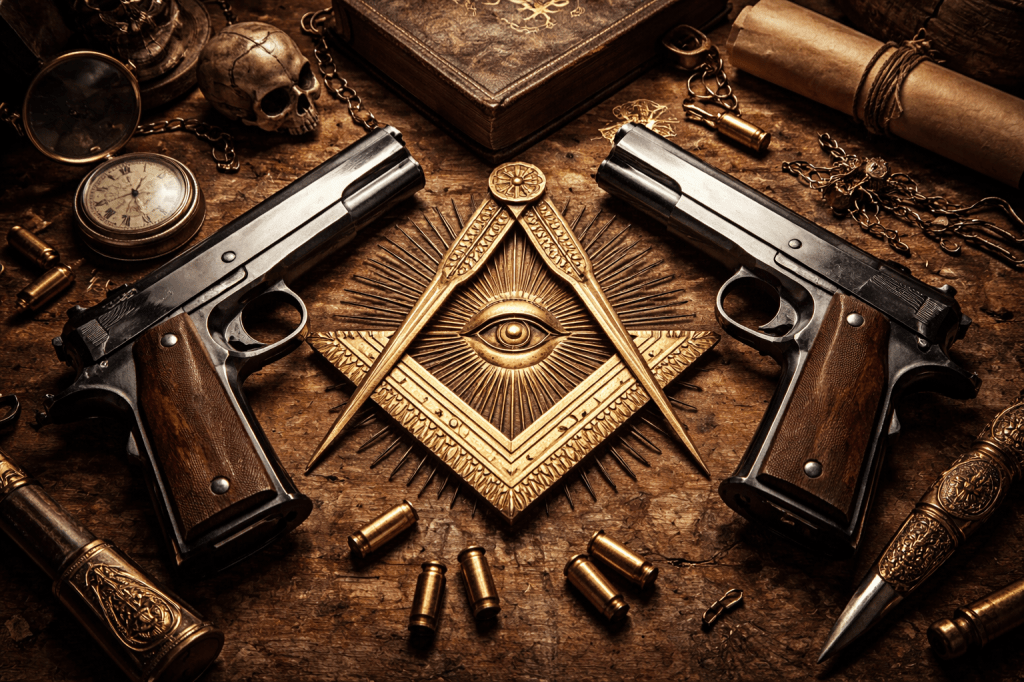
Editors Note: This is an article that I do not publish without hesitation. This topic has been troubling for me for my entire Masonic journey. The below post is meant with respect and hopefully the reader enters the conversation with an open mind.
_________________________________________________________________________________
Freemasonry has long understood something that the modern world keeps forgetting: not every subject belongs in every room. That is why, inside the Lodge, we do not argue politics or religion. The rule is not there because those subjects are unimportant. It is there because they are important enough to divide men who would otherwise meet as Brothers. The Lodge is meant to be a place where conviction is tempered by charity, and where harmony is guarded on purpose.
That is why I have been thinking about firearms and Masonic fundraising.
To be clear, this is not an argument that every Mason who owns a gun is making a political statement. Many good men own firearms for hunting, sport, collecting, personal protection, or simple family tradition. In many parts of the country, that is ordinary life. A gun, considered only as an object, may be lawful, useful, and familiar.
But objects do not live in a vacuum. They live in culture. And in American culture, firearms are no longer merely tools. They are also powerful political symbols.
The numbers make that hard to deny. Pew Research found in 2024 that 45% of Republicans and Republican-leaning independents said they personally own a gun, compared with 20% of Democrats and Democratic leaners. In the same research, 83% of Republicans said protecting gun rights is more important, while 79% of Democrats said controlling gun ownership is more important. Pew also found that 81% of Republicans said gun ownership does more to increase safety, while 74% of Democrats said it does more to reduce safety. When one object is tied that strongly to party identity, public policy, and opposite moral intuitions about safety, it has plainly crossed the line from neutral item to contested symbol.
Gallup points in the same direction. In its November 2024 polling, 56% of Americans overall said gun laws should be stricter, but the partisan split was enormous: 89% of Democrats supported stricter gun laws, compared with only 25% of Republicans. That matters for a Lodge setting. A gun raffle or firearm giveaway may be intended as a practical way to raise money, but it will not be received by everyone as a merely practical thing. For some Brothers, and certainly for some family members or visitors, it may look like the Lodge has chosen a side in one of the country’s most polarizing public arguments.
And this is not only an abstract political debate. According to CDC mortality data for 2024, the United States recorded 44,447 firearm deaths. Separate CDC suicide data show 27,593 firearm suicides in 2024, and CDC homicide data show 20,162 homicides overall in 2024, though not all homicides involved firearms. Those figures do not settle every policy question, and they should not be weaponized for rhetoric. But they do remind us that firearms are connected in the public mind not only with rights and recreation, but also with grief, fear, and loss. When a Lodge uses a gun as a fundraising centerpiece, it may unintentionally bring all of that emotional and political freight into a space that is supposed to be protected from precisely those divisions.
There is also an important nuance here. This issue is not simple, and it is not neatly reducible to party slogans. Pew Research’s December 2024 fact sheet found that majorities of both Republicans and Democrats supported raising the minimum age for buying a gun to 21, including 69% of Republicans and Republican leaners and 90% of Democrats and Democratic leaners. That is worth noting because it shows the country is not divided into cartoon camps of “all for” and “all against.” Even so, the broader debate remains unmistakably political. The very fact that gun questions are measured constantly by party, ideology, and election behavior tells us something important about their public meaning.
So the question for a Lodge is not simply, “Is a firearm legal?” Nor is it even, “Would some Brothers like it?” The better question is, “Does this help preserve harmony among men of different views?” That is a more Masonic question. A thing can be lawful and still be unwise. A thing can be popular with many and still place an unnecessary burden on the peace of the Lodge.
For that reason, I think firearm-centered fundraisers deserve more caution than they often receive. Even where no political speech is made, the symbolism may already be doing the speaking. And when the symbol itself is bound up with one of the sharpest political divides in American life, a Lodge should at least pause before placing that symbol at the center of its public activity.
Freemasonry does not ask men to stop having convictions. It asks them to govern those convictions in the interest of something higher: brotherhood, restraint, and peace. Sometimes that means avoiding not only explicit arguments, but also the kinds of public gestures that carry an argument inside them.
A Lodge does not become less Masonic by raising money. But it may become more Masonic by asking whether the way it raises money strengthens harmony or quietly strains it.
 Three Burning Tapers
Leave a comment