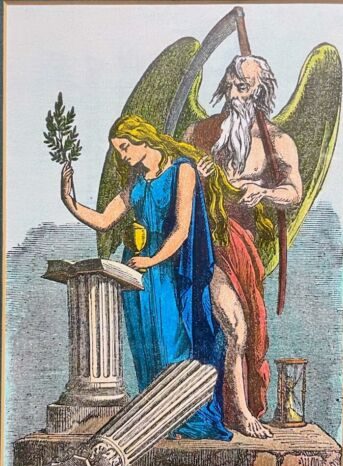
One of the most poetic and haunting passages in all of Freemasonry comes during the Master Mason degree, as the candidate circumambulates the Lodge for the final time. It’s here that we hear the words from Ecclesiastes 12: “Remember now thy Creator in the days of thy youth…”
A lot of who have sat through what is my favorite Degree, have heard this piece of scripture and either a) let the brain wander or b) got confused as to why we’re talking about grasshoppers and dark windows or c) you’re smarter than I and if so, well, you can just skip this post and go about your day.
But I’ll continue for those who want to learn more.
What I love about this particular verse and it’s connection to the Master Mason Degree is that the scripture used here is solemn, has great imagery, and it’s a hidden call to action. Carpe Diem if you will.
This message was the heart of a Lodge Education presentation I gave a few years ago that still sticks out to me. I invited the Brethren to look more deeply at what this passage means—not just for the candidate in the degree, but for each of us as Masons, regardless of age or experience.
Why does Solomon’s meditation on aging, decay, and spiritual return appear at the moment a man is raised to the highest degree in Freemasonry? What can we learn from the metaphors of the silver cord and the golden bowl, the darkened windows, and the grasshopper that becomes a burden?
In this post, I’ll share how Ecclesiastes frames the Master Mason’s journey, how it invites each of us to reflect on the fleeting nature of time, and how it urges us—symbolically and literally—to “walk uprightly” while we still can.
A Little Background About This Chapter, Verse, and the Author
Ecclesiastes is attributed to Solomon, a figure who, in the Biblical narrative, had seen it all—wisdom, wealth, pleasure, and sorrow. He opens the book with a jarring declaration: “Vanity of vanities, saith the Preacher, vanity of vanities; all is vanity.”It’s not a pessimistic message, but a grounding one. Solomon is warning us not to place our trust in things that pass—wealth, fame, even our own strength. I’m reminded me of what my father once told me, “You don’t see a U-Haul following a hearse.” Which is redneck I guess for “You don’t get to take the things you buy with you into the great unknown….everything is vanity”
In chapters 1 through 4, Solomon reflects: Been there, done that. He had tasted every experience life could offer, and yet found it all fleeting. In chapters 5 through 8, the tone shifts to advice—how one might live wisely in a world that cannot be controlled. And by chapters 9 through 11, the counsel becomes more urgent: Do not delay. Do good while you still can. Rejoice in life before the light dims.
The Master Mason’s Passage
Then comes chapter 12—the centerpiece of the Master Mason circumambulation. In poetic form, it describes the slow breakdown of the human body and the final return of the spirit to God. The metaphors are layered:
- The keepers of the house shall tremble—our hands grow weak.
- The strong men shall bow themselves—our legs give way.
- The grinders cease because they are few—our teeth fail.
- Those that look out the windows be darkened—our eyes grow dim.
- The golden bowl is broken, the silver cord loosed—life itself departs.
This passage, read aloud as the candidate circles the Lodge, reminds him that the journey he is on is not merely ritual, but a reflection of the true journey we all take—from birth, through life, toward that final undiscovered country. I often look at the three Degrees as the journey in life and well, the Master Mason Degree is the reminder that we too shall pass.
Why This Scripture?
Some might ask: if the Master Mason degree represents the senior stage of Masonic development, why are we quoting a passage that addresses youth?
The answer lies in both the operative and speculative understandings of Masonry.
Operatively, “youth” is a relative term. In Solomon’s time, a man might be considered mature in his twenties and old by his forties. The lesson was not just for children, but for all who still had time left to act.
Speculatively, we are reminded that time is a gift. Being raised as a Master Mason is not the end—it is the beginning of a life lived with purpose. The degree is not a capstone but a launching point. You are now fully a Mason; what will you do with the time that remains?
I was reminded of this simple lesson this week when someone that I used to work with, age 59 years young, went golfing on Saturday and had a brain aneurism that took his life. This man, not that much older than I, woke up and was having a great day and was no longer on this world in the snap of your fingers.
…..man knoweth not his time.
A Call to Action
Ecclesiastes 11:9–10 offers a profound encouragement: “Rejoice, O young man, in thy youth… walk in the ways of thine heart… but know thou that for all these things God will bring thee into judgment.”
Enjoy life. Embrace your path. But understand that what we do matters.
This is a lesson for the Lodge as well. Our time together is limited. We only meet so many times. We only confer so many degrees. We only get so many nights to break bread and share light with our Brothers. Let us make the most of each of them.
The Dust Returns…
The final words of the circumambulation are sobering: “Then shall the dust return to the earth as it was: and the spirit shall return unto God who gave it.”
This isn’t a threat. It’s a promise. A reminder of the natural cycle, and of the divine spark within us. It’s a call to remember who we are, where we came from, and what really matters.
Final Thought
At the conclusion of Ecclesiastes, Solomon returns to his central theme: “Vanity of vanities, saith the Preacher; all is vanity.” But by this point, the words ring differently. We are not meant to despair. We are meant to live fully, mindfully, gratefully.
To my Brothers in the Craft: remember your Creator. Remember your purpose. And remember each other.
S.M.I.B.
 Three Burning Tapers
Leave a comment